Best Sonoff for Geyser Control in South Africa — The Complete Guide
March 10, 2026 · Jason Marriott
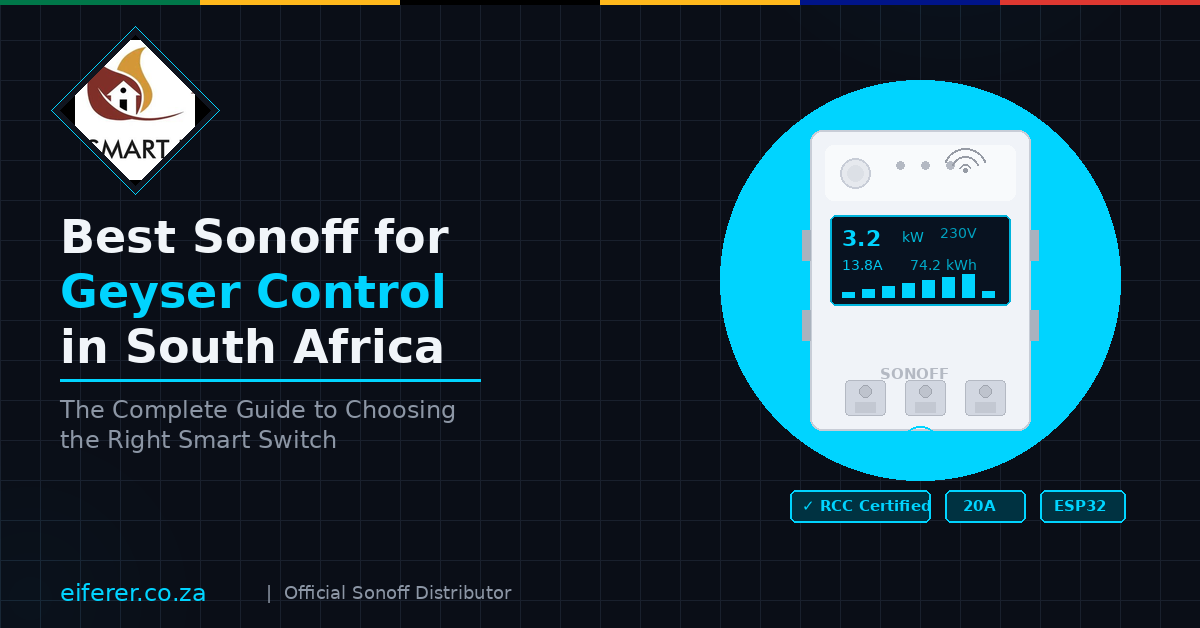

The Sonoff POW Elite POWR320D — the smart geyser timer built for South Africa
Your geyser is quietly draining your wallet. It's the single biggest electricity consumer in most South African homes, responsible for up to 40% of your monthly bill. The good news? A smart switch costing under R500 can put you back in control — scheduling when your geyser heats, monitoring exactly how much power it draws, and even cutting it off if something goes wrong.
But here's the catch: not all smart switches are created equal, and the wrong one on your geyser can cost you far more than the money you were trying to save. In this guide, we'll break down exactly which Sonoff switch works for which geyser, what to avoid, and why certification matters more than most people realise.
Check Your Element, Not Your Geyser Size
This is the single most important thing to understand before buying a smart geyser switch, and it's something almost nobody talks about.
When people ask "will this switch work on my 150L geyser?" they're asking the wrong question. The litre size of your geyser is just a guide — it's the element wattage that determines whether a switch can handle it.
As a general guide, South African geysers typically come with these element sizes:
- 100L geyser — usually fitted with a 2kW element
- 150L geyser — usually fitted with a 3kW element
- 200L geyser — usually fitted with a 4kW element
But this is not a hard rule. We've seen 200L geysers running 3kW elements, and it's entirely possible to find a 150L geyser with a non-standard element fitted during a replacement or repair.
Before you buy any smart switch for your geyser, check the actual element rating. You can find this on the rating plate on the geyser itself, or check the circuit breaker size on your DB board — a 3kW element draws roughly 13 amps, while a 4kW element draws about 17 amps.
Which Sonoff for Which Geyser?
The POWR320D (POW Elite 20A) — For Elements Up To 3kW
Sonoff POW Elite POWR320D — View Product
This is the one most South African homes need.
The Sonoff POW Elite POWR320D is a 20-amp smart power meter switch that handles elements up to 3kW comfortably. That covers the vast majority of 100L and 150L geysers, and even some 200L geysers that have been fitted with smaller elements.
What makes it the standout choice:
- Real-time LCD display showing power, voltage, current, and cumulative consumption — you can see exactly what your geyser is costing you without even opening the app
- 6 months of hourly consumption history, exportable to Excel through the eWeLink app — perfect for tracking whether your geyser habits are actually saving you money
- Customisable overload protection — set thresholds for power, current, and voltage, and the switch automatically cuts off if any limit is exceeded
- Hardware-level overload cutoff — if the amps exceed the rating, the switch shuts down. This was added as a direct improvement over the older POW R2, which had widespread failures from overloaded geysers
- DIN rail mountable — fits neatly in your DB board alongside your existing circuit breakers
- ESP32 chip — 200% faster than the previous generation, with better Wi-Fi stability
- V-0 flame retardant enclosure — the highest fire safety rating for plastic housings
- Works with Alexa, Google Assistant, and Home Assistant via the eWeLink add-on
- RCC Certified by NRCS and ICASA — more on why this matters below
The POWR316D (POW Elite 16A) — For 2kW Elements
If you have a smaller geyser with a 2kW element (typically 100L), the 16-amp version does everything the 320D does but at a lower current rating. Same LCD, same monitoring, same app features — just rated for lighter loads.
This is also a great choice for pool pumps that draw under 16 amps.
The POWR3 (25A / 5500W) — For Larger Elements, But With a Catch
If your geyser has a 4kW element and you absolutely need power monitoring, the Sonoff POWR3 handles up to 25 amps and 5500 watts. On paper, it's the answer for bigger geysers.
The problem is practical: the POWR3 measures 162 x 122 x 46mm. That's massive — bigger than a Sonoff 4-channel relay. It simply doesn't fit comfortably in a standard residential DB board. For most home installations, it's not a realistic option.
The BasicR4 + Contactor — The Smart Alternative for Big Geysers
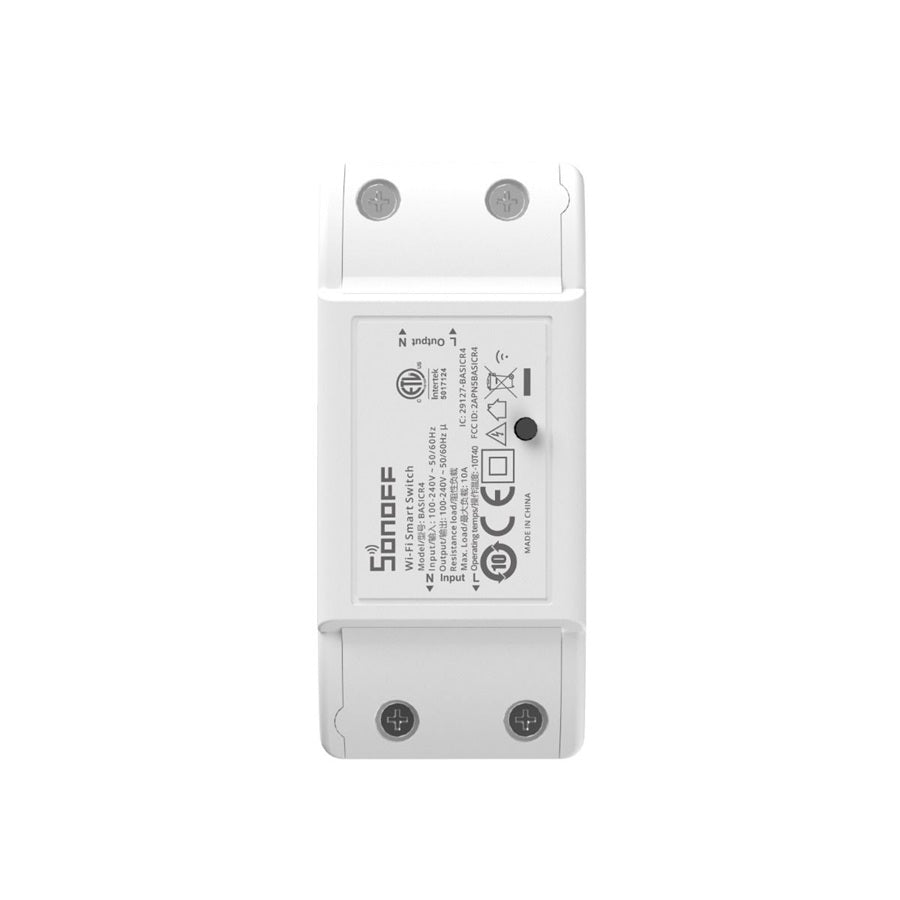
Sonoff BasicR4 — View Product
If your geyser has a 4kW element (or larger) and the POWR3 is too bulky, there's a practical workaround that electricians have been using for years: pair a Sonoff BasicR4 with a contactor.
Here's how it works: the BasicR4 is a compact 10-amp smart switch. On its own, it can't handle a geyser. But when you wire it to control a contactor (an electrically operated switch rated for high current), the BasicR4 switches the contactor's coil, and the contactor switches the geyser.
The trade-off: you get full scheduling, remote on/off, and voice control — but no power monitoring. If you need to know exactly how much your geyser is consuming, this setup won't tell you. But if your main goal is to schedule your geyser for off-peak hours and control it from your phone, it does the job affordably and safely.
Your electrician will know how to set this up — it's a standard configuration.
Why "Max" Doesn't Mean "Comfortable"
This is something we see people get wrong constantly, and it's worth explaining clearly.
Just because a switch is rated for 20 amps doesn't mean you should run it at 20 amps all day. The rated maximum is the ceiling — not the target. Running any electrical device consistently close to its maximum shortens its lifespan significantly.
On top of that, geysers spike on startup. When your geyser element first kicks in, the initial current draw is higher than the steady-state running current. It settles back down quickly, but that spike is real and it matters.
This is exactly why Sonoff built hardware-level overload protection into the POWR320D and POWR316D. If the current exceeds the rated limit, the switch cuts off automatically. This was a direct response to the problems with the older POW R2 — a 16-amp switch that saw widespread failures because people were connecting it to geysers that drew more current than it could safely handle.
The takeaway: match your switch to your element with headroom to spare. A 3kW element on a 20-amp switch leaves comfortable margin. A 3kW element on a 16-amp switch is cutting it too fine.
RCC Certification: Why It Matters and Why You Should Ask
The Sonoff POWR320D is RCC certified in South Africa by the NRCS (National Regulator for Compulsory Specifications) and ICASA. This means it has been tested and approved for use in the South African market, and it complies with local electrical regulations.
Why should you care?
Because if something goes wrong — a fire, water damage from a burst geyser, any incident involving your electrical system — your insurance company will send an assessor. That assessor will look at what's connected to your DB board. If they find uncertified, non-compliant devices, it could void your claim.
This isn't a theoretical risk. Insurance companies in South Africa are increasingly aware of smart home devices being installed on geysers, and they want to see that those devices meet local standards.
Here's something most people don't know: each importer must obtain their own RCC certification. It's not a blanket approval that covers every Sonoff device entering the country. Just because the product is a genuine Sonoff doesn't automatically mean the batch you're buying has been certified for the South African market.
Our advice: ask your supplier to confirm they hold valid RCC or NRCS certification for the Sonoff products they're selling. If they can't show it, that's a red flag. At Eiferer, we hold the RCC certification for the Sonoff POW range of products we import and distribute — it's something we invested in specifically because we believe it matters for our customers' peace of mind and safety.
A Warning About Cheap "Smart Circuit Breaker" Alternatives

⚠️ Generic 63A eWeLink circuit breaker — no NRCS or RCC certification in South Africa
You've probably seen them online — generic DIN-rail mounted "smart circuit breakers" that claim to handle up to 63 amps, work with the eWeLink app, and cost R300–R450. They look like a bargain compared to the Sonoff range. They're marketed as geyser timers, pool pump controllers, and general-purpose smart switches.
We strongly advise against using these on your geyser. Here's why.
We looked into getting these devices certified for the South African market. We couldn't. They failed the certification process.
These generic switches — typically unbranded or manufactured by companies you've never heard of — have several serious problems:
No NRCS or RCC certification. We have not found a single retailer in South Africa that lists NRCS, RCC, or ICASA certification for these devices. The sellers themselves often note that these switches "do not replace a DB board breaker" — because they're not certified as circuit breakers despite looking like one.
Known overheating issues. These devices have been reported to overheat, particularly under sustained high loads like a geyser running for extended periods. The chipsets used (typically the CK-BL602) don't have the same thermal management as the ESP32 used in genuine Sonoff products.
No LAN mode. Many of these generic breakers are cloud-only — if your internet goes down, you lose all control over the device. The Sonoff range supports LAN mode, meaning it can still function locally without an internet connection.
Firmware instability. There are reports from South African users of these devices bricking or becoming unresponsive after firmware updates, requiring a full power cycle to restore functionality.
The insurance risk. This is the big one. If an insurance assessor finds an uncertified, non-compliant device on your geyser circuit after a fire or water damage incident, you may face a denied claim. The few hundred rand you saved on the switch could cost you your entire claim.
The bottom line: for something as critical as your geyser — a high-power, always-on appliance connected to water and electricity — this is not the place to cut corners.
Installation Safety: The Non-Negotiables
No matter which Sonoff switch you choose for your geyser, these rules apply:
Do NOT install inside the roof. This is printed on the product itself and it's not optional. Roof spaces in South Africa get extremely hot, especially in summer. The combination of ambient heat and the heat generated by the switch under load will cause overheating and premature failure. Mount the switch in your DB board or in a dedicated enclosure in a ventilated area.
Crimp cable tips onto electrical lugs before insertion. Don't just strip the wire and push it in. Proper crimped ferrules ensure a solid, low-resistance connection that won't work loose over time. Loose connections generate heat, and heat on a geyser circuit is dangerous.
Have it installed by a qualified electrician. This is a legal requirement in South Africa for any work on your DB board. It also ensures that the wiring is done correctly, the correct circuit breaker is in place upstream, and your certificate of compliance (CoC) remains valid.
How the Savings Actually Work
A smart geyser switch isn't magic — it saves money through intelligent scheduling and awareness.
Scheduling: Set your geyser to heat water only when you need it. For most families, that means heating in the early morning before everyone showers, and again in the late afternoon before evening use. The rest of the day, the geyser is off and you're not paying to maintain hot water that nobody is using.
Monitoring: Once you can see exactly how much your geyser consumes (the POWR320D shows this on the LCD and in the app), you start making smarter decisions. You might discover your geyser is cycling more than expected, which could indicate a failing thermostat or poor insulation — problems that cost you money every single day until they're fixed.
Alerts: Set daily or monthly consumption thresholds in the eWeLink app. When your geyser hits the limit, you get a push notification. This catches problems early — a sudden spike in consumption often means something has changed that needs attention.
Remote control: Going away for the weekend? Turn the geyser off from your phone. Coming home early? Turn it back on an hour before you arrive. No more heating water in an empty house.
For a typical South African household, properly scheduling your geyser can save R300–R600 per month on electricity. The POWR320D pays for itself within the first month or two.
Quick Reference: Which Switch Do I Need?
| Your Geyser Element | Recommended Sonoff | Power Monitoring |
|---|---|---|
| 2kW (typically 100L) | POWR316 (16A) | Yes — App |
| 3kW (typically 150L, some 200L) | POWR320D (20A) | Yes — LCD + App |
| 4kW+ (typically 200L+) | BasicR4 + Contactor | No — schedule/remote only |
| 4kW+ (need monitoring) | POWR3 (25A) | Yes — App only |
Remember: check your element size, not your geyser litre size. The element wattage is what matters.
Why Buy From an Official Distributor?
Eiferer is an official Sonoff distributor based in Gauteng. We hold the RCC certification for the Sonoff products we sell, which means every unit we ship has been through the proper certification process for the South African market.
We provide local support, genuine products with valid warranties, and the documentation to prove compliance if you ever need it. When your insurance assessor asks about that smart switch on your geyser, you want to be able to show them it came from a certified source.
Browse Our Sonoff Geyser Timers
Free delivery on orders over R2,500 · Gauteng-based · Same-day dispatch before 2PM